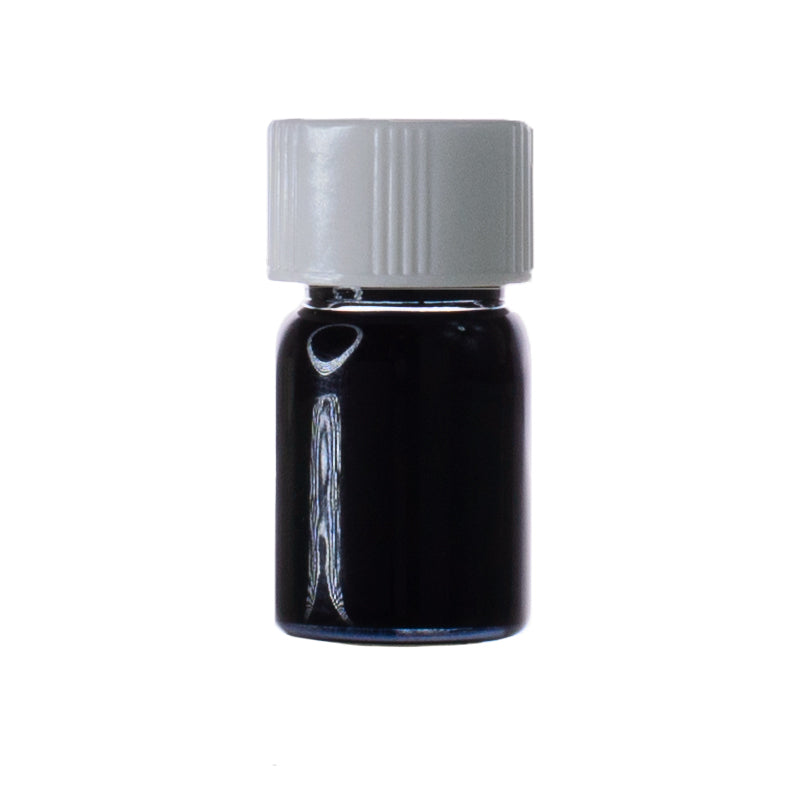
BLUE TANSY: QUINTESSENTIAL CALM FOR COMPLEXIONS
Beloved Blue Tansy Essential Oil is a blue bundle of phytochemical finesse and sweet-scented care! While the yellow-orb flowers of Tanacetum annuum tantalize honeybees, the oil expressed from this plant is a superhero-skin-savior, a skin elixir with each drop like a refreshing dip in a cool lake. This benevolent botanical cools heated emotion and reactive skin, acting as a true-blue tonic that gives the spirit a deep drink of serenity.
The legendary perfumer-chemist and olfactory chronicler Steffen Arctander was particularly enamored by its scent. In his 1960 work, Perfume and Flavor Materials of Natural Origin, he describes the essence with aromatic precision:
"The odor of the oil is sweet, heavy, and fruity, almost apple-like... the fragrance is warm-herbaceous, somewhat balsamic, spicy, and very tenacious. It is a very interesting oil for the creative perfumer, offering a combination of fruity and spicy notes rarely found in a single material.”
In his monumental six-volume work, The Essential Oils, Ernest Guenther provides a technical profile of Blue Tansy (Tanacetum annuum), a "wild and abundant" Moroccan annual that he carefully distinguishes from the common Tansy variety. He was captivated by its rugged botanical vigor, describing the essence as "intense, herbaceous scent with a distinctive apple-like, fruity undertone and soft, diffusive camphoraceous notes". Guenther explains that its striking, vibrant deep blue color, a result of chamazulene forming from the precursor matricin during steam distillation, is a mark of excellence; he notes that the color "should be pure, as discolored oils indicate inferior quality". Often referring to it as "Moroccan Tansy," he highlights its chemistry as a distinct scent symphony, capturing a "high-potency spiritus" that carries the rugged resilience of the North African wild. In the late 20th century, the research of Dr. Franchomme and Dr. Penoël in their definitive text, L’aromathérapie exactement, scientifically documented the oil's bioactive profile. They identified the oil as "l’huile anti-allergique par excellence," documenting its antihistamine and anti-inflammatory properties as foundational to clinical care.
"This oil is striking not only for its blue color – due to its high azulene content – but also because of its sweet, aromatic scent.” — Kurt Schnaubelt, Advanced Aromatherapy
BLUE TANSY: APPLICATIONS
Skincare is where Blue Tansy beautifies, as evidenced by its presence in so many restorative Libations formulations, from All Seeing Eye Crème to BeDewDab. This oil is a supreme skin soother; we recommend applying it to skin that needs calm or diluting it with Jojoba to create calming serums for hot, red complexions. Beyond topical use, it is a "bathing beauty" and a "true blue friend" for combining with Peppermint or Eucalyptus for a blue-hued sinus soother and mover when inhaled via a salt pipe, Nose Glow or diffuser. Whether whiffed right from the bottle or used as a head-to-toe body blessing, it remains a quintessential blue essence for skin solace.
BOTANICAL PROFILE
Botanical Name: Tanacetum annuum
Botanical Family: Asteraceae
Extraction Method: Steam distilled
Part of Plant Distilled: Flowers
Country of Origin: Morocco
Cultivation Method: Wild harvested
Composition: 100% Tanacetum annuum
Consistency: Thin
Scent Description: Sweet and richly complex, with herbaceous notes of wood and wild apples.
Blends Beautifully: Rose, Frankincense, Lemon, Cardamon, Firs, Rosemary, Lavender, Spikenard, German Chamomile, Yarrow, Palo Santo, Immortelle, Sandalwood, Marjoram, Bergamot, and Peppermint.
In Living Libations: All Seeing Eye Crème, Open Sky Eye Serum, BeDew Dab, Chamomile Vanilla Lover Lips, Grapefruit Stellar Renewal, Maverick Face Crème, Mint Condition Lip Fix, Zippity DewDab, Zippity DewDab Ozonated Beauty Balm, True Blue Spirulina Shampoo, True Blue Conditioner, Longevity Liquid, Tonic Reviving Roll On, Peppermint Pal.
Key Constituents: The Azulene Blue Anchor
The phytochemical spiritus of Blue Tansy is defined by its copious concentration of chamazulene, the sesquiterpene that creates the bold indigo hue, the quintessential antidote for all things “red”. While there are three deep-blue essential oils, including Yarrow and German Chamomile, Blue Tansy's quintessential calm differs because its azulene is anchored by a significant concentration of sabinene (20%), which bestows its clarifying and herbaceous energy. This is supported by a soothing tapestry of camphor (12%) and myrcene (5%), creating a molecular architecture that is aromatically enchanting. Camphor compounds are rare and the juicy amount here is a sophisticated surprise; differing from the crisp-camphor of evergreen oils, Blue Tansy’s camphor is delivered in a "sesquiterpene-soft" package, where the blue molecules buffer the ketones to provide a clarifying synergy that feels gentle on both the skin and spirit. The presence of beta-pinene and p-cymene provides a sweet, subtle resinous edge, while the overall high azulene content ensures the oil remains a true blue beauty.
View or download the Certificate of Analysis.
This essential oil is verified, genuine distillation, third-party tested to ensure 100% purity.
THE CALMING CHAMOMILES: A PHYTOCHEMICAL SYMPHONY
These botanical cousins of the Asteraceae family share a floral family resemblance. Chamomile carpets in wild meadows all look beautifully alike, blanketing fields with dainty, mini-daisy-like white petals haloing bright golden centers, topped with the sweet, classic apple-aroma of Chamomile, from the Greek chamaimēlon, meaning "earth-apple." Yet, beneath their pearly petals lives a diverse internal alchemy. While all Chamomiles are cherished for their calming charisma and as skin-soothing elixirs, they embody distinct fragrant phytochemical footprints that guide their specialized enjoyment.
Chamomile (Anthemis nobilis)
Living Libations classic Roman Chamomile with its noble reputation as a restorative remedy and complexion calmer, is primarily defined by a high concentration of esters. It is abundant in 2-methylbutyl angelate (15%), methallyl angelate (10%), and 3-methylpentyl angelate (9%). This high-ester density makes it a graceful essence to soothe restlessness and tune into tranquility. These esters are valued for their skin-softening qualities and “serenity now” disposition. Its herbaceous-ambrosial aroma is welcoming, honeyed, and topped with a warming note reminiscent of "ripened apples on hay" that deepens into a smooth, tenacious, tea-like dry-down.
Wild Moroccan Chamomile (Ormenis multicaulis)
This wild Chamomile variety is the "botanical maverick" of the family, characterized by a more astringent and clarifying profile than the lullaby esters of the classic Anthemis nobilis variety. Phytochemically, it is anchored by a significant monoterpene footprint of alpha-pinene (16%), 1,8-cineole (9%), and santolina alcohol (8%). This variety is a salient skin savior particularly prized for balancing oily complexions and rejuvenating the appearance of scars. Its spiritus emanates a forest-like top note and a tenacious, herbaceous, slightly balsamic dry-down.
German Chamomile (Matricaria recutita)
This cobalt-colored Chamomile essential oil is the inky-blue "go-to" for addressing dermal distress. The botanical name Matricaria recutita means “mother’s plant that blooms again,” honoring this chamomile’s legacy as a comforting herbal helper for the birthing process. The oil's signature blue dew drops are saturated in a substantial 45% concentration of trans-beta-farnesene, a sesquiterpene that defines its deep oceanic calm. Working in tandem is the very special compound chamazulene. While it doesn’t exist in the fresh plant itself, this intense blue compound is miraculously born during the gentle steam distillation process. Chamazulene is a legendary antioxidant; its sapphire hue serves as the ultimate soothing antidote for anything red, hot, or irritated. Combined with alpha-bisabolol (10%), German Chamomile stands as a true-blue "dermal do-all." Its scent is deep and sweet, described as herbaceous-tobacco-like and slightly fruity, with a rich, comforting, hay-like sweetness.
Blue Tansy (Tanacetum annuum)
Often called "Moroccan Chamomile" and sometimes mislabeled as German Chamomile, this oil is a botanical treasure of phytochemical finesse. While it shares the indigo hue of the German variety, its quintessential calm is uniquely anchored by a significant concentration of sabinene (20%) and myrcene (5%). It also contains a robust chamazulene content averaging up to 11% depending on the harvest, though it is completely without the alpha-bisabolol found in German Chamomile. Containing a rare chamazulene and camphor combination at a hearty 12% provides the clarifying, camphorous, and herbaceous synergy that differs from true Chamomiles, making it an essential anchor in skincare formulations for hyper-reactive skin. The unique presence of camphor creates a beautifully camphorous, cooling blend that helps with histamine-like reactions, elegantly easing flare-ups, taking the heat out of puffiness, and quelling itchiness. Aromatically, it is a "superhero-skin-savior" that smells like a sun-warmed orchard of wild apples and honey, offering a fruity-floral sweetness rarely found in a single material.
Cape Chamomile (Eriocephalus punctulatus)
This fragrant, floral dream is a favorite, featuring a luminous aquamarine hue and a complex combination of esters and sesquiterpenes that act as "super soothers". Cheery Cape Chamomile beautifully combines the skin-loving qualities of both Roman and German varieties, containing a delicate, subtle whisper of chamazulene at just 0.40%. This trace amount is precisely what creates its soft, magical azure tone. Each dewy drop bedews a sophisticated, ester-saturated profile uniquely anchored by two exceptional, rare calmative molecules: 2-methylbutyl isobutyrate at an abundant 28% and isobutyl isobutyrate at 14%. These ample aliphatic esters envelop the skin in a serene substance that revives the radiant spiritus of the complexion while giving the oil its laid-back vibes. Its scent easily surpasses its botanical cousins as a fine berry-floral fragrance that is highly sought after in luxury perfumery. Cape Chamomile is completely distinct for its invitingly fruity, honeyed, and light floral notes that are perfectly pleasant for everyone.
BLUE TANSY: FREQUENTLY ASKED QUESTIONS
How is Blue Tansy different from "Tansy" essential oil?
It is vital to distinguish between Blue Tansy (Tanacetum annuum) and Common Tansy (Tanacetum vulgare). While they share a genus, they are chemically worlds apart. Common Tansy is high in thujone, and generally not used in essential oil aromatherapy or skincare. Blue Tansy, by contrast, is low in thujone and rich in soothing chamazulene and sabinene, making it a safe, benevolent "skin do-all" that is cherished for its calming, quelling qualities.
Why is the oil blue if the flowers are yellow?
Just like German Chamomile, the blue color is a result of the steam distillation process. The heat transforms the natural matricin in the yellow flowers into chamazulene, creating that iconic, indigo-inky elixir.
Is Blue Tansy a wild species?
Yes, it is often described as a "wilder" species compared to cultivated Chamomiles. It thrives in the sunny, semi-arid regions of Morocco, and our oil is wild-harvested to ensure it retains the rugged, high-potency spiritus of its Mediterranean home.